Chess Board Setup: The Foundation of Every Chess Game
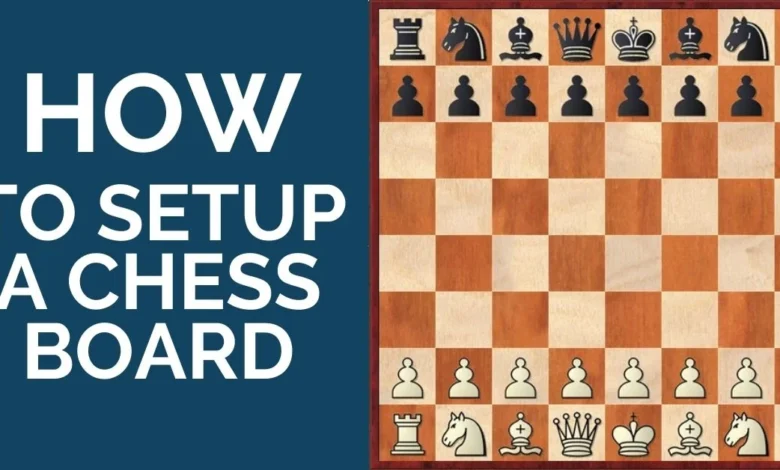
Chess is a game of precision, strategy, and discipline, and every match begins with a properly arranged board. Correct chess board setup is essential not only for fair play but also for understanding the structure of the game itself. From professional tournaments to casual matches at home, setting up the chessboard correctly ensures that both players start on equal terms. A clear understanding of chess board setup is one of the first and most important steps for anyone learning the game.
Understanding the Chessboard Layout
A standard chessboard consists of 64 squares arranged in an eight-by-eight grid. The squares alternate between light and dark colors, traditionally referred to as white and black. The board is positioned so that each player has a light-colored square in the bottom-right corner. This detail is crucial, as incorrect board orientation leads to incorrect piece placement and invalid gameplay.
The rows of the board are called ranks, numbered from one to eight, while the columns are called files, labeled from “a” through “h.” This coordinate system is used to describe moves, analyze positions, and record games. Understanding the layout of the board helps players visualize strategies and communicate moves accurately.
Orientation of the Chessboard
Before placing any pieces, proper orientation of the board must be confirmed. Each player should see a light square on their right-hand side in the nearest corner. A common phrase used to remember this is “white on the right.” If the board is rotated incorrectly, the position of the queen and king will be reversed, which changes the entire structure of the game.
Correct orientation ensures symmetry and fairness. In official competitions, referees carefully check board orientation before the start of a match to avoid disputes or confusion.
Placement of the Pawns
Pawns are the simplest chess pieces, yet they play a vital role in controlling the board. Each player begins the game with eight pawns. These pawns are placed on the second rank for White and the seventh rank for Black. The pawns occupy all eight files, forming a solid line in front of the more powerful pieces.
Proper pawn placement is essential because pawns shape the early stages of the game. Their initial positions allow players to contest the center of the board and create pathways for development. A misplaced pawn can disrupt the entire setup and affect opening strategies.
Placement of the Rooks
Rooks are placed in the corners of the board. Each player has two rooks, which occupy the squares at the far left and far right of the first rank for White and the eighth rank for Black. Rooks are powerful pieces, especially in open positions, and their placement on the corners allows them to control entire ranks and files as the game progresses.
Starting in the corners also enables special moves such as castling, which plays a crucial role in king safety and rook activation.
Placement of the Knights
Knights are placed next to the rooks, one square inward from each corner. Each player’s knights occupy the b and g files on their respective back ranks. Knights are unique in their movement, able to jump over other pieces, and their initial placement allows them to quickly move toward the center of the board.
Proper knight placement ensures balanced development and gives players flexible options in the opening phase of the game.
Placement of the Bishops
Bishops are placed next to the knights, closer to the center of the board. Each player has two bishops, one starting on a light square and the other on a dark square. The bishops are placed on the c and f files of the back rank.
This placement ensures that each bishop controls diagonals of a specific color. Maintaining this balance is essential for long-term strategy, as bishops often dominate open diagonals and contribute significantly to both offense and defense.
Placement of the Queen and King
The final pieces to place are the queen and the king. The queen is always placed on the square that matches her color. The white queen goes on a white square, and the black queen goes on a black square. This places the queens on the d file for both sides.
The king is placed on the remaining central square next to the queen, on the e file. This arrangement is critical, as reversing the positions of the king and queen results in an illegal setup. The correct placement ensures symmetry and enables key mechanics such as castling.
Importance of Correct Setup in Competitive Play
In professional chess, correct board setup is taken very seriously. An incorrectly set board can lead to invalid games, penalties, or even forfeiture in tournament play. Players are responsible for checking the setup before the clock starts, and arbiters are present to resolve any issues.
A proper setup also ensures that opening theory and established strategies can be applied correctly. Since many openings rely on precise piece placement, even a small error in setup can render an opening ineffective or illegal.
Common Setup Mistakes to Avoid
One of the most common mistakes in chess board setup is incorrect board orientation. Placing the dark square on the bottom-right corner leads to reversed queen and king positions. Another frequent error is swapping the king and queen, which often occurs when players forget that the queen goes on her own color.
Beginners may also misplace bishops or knights, especially when setting up quickly. Taking a few extra moments to double-check each piece’s position helps avoid these mistakes and ensures a fair start.
Chess Board Setup as a Learning Tool
Learning proper chess board setup helps players develop discipline and attention to detail. These qualities are essential not only in chess but also in other competitive sports and intellectual pursuits. Teaching beginners to set up the board correctly reinforces fundamental knowledge and builds confidence.
Many coaches emphasize board setup as part of early training, encouraging players to visualize the board and understand the relationship between pieces. This foundational skill supports deeper learning and long-term improvement.
Conclusion
Chess board setup is the foundation upon which every chess game is built. From proper board orientation to precise piece placement, each detail plays a role in ensuring fairness, consistency, and strategic integrity. Understanding and mastering chess board setup is essential for players of all levels, from beginners to professionals.
A correctly arranged board allows players to focus on strategy, creativity, and competition without distractions. By respecting the fundamentals of chess board setup, players honor the tradition of the game and prepare themselves for meaningful and competitive play.




One Comment