Rugby World Cup Winners: A Complete History of Champions
The Rugby World Cup is the most prestigious tournament in international rugby union, bringing together the strongest national teams from around the globe. Since its inception in 1987, the tournament has produced legendary moments, iconic players, and dominant champions who have left a lasting impact on the sport. Understanding the history of Rugby World Cup winners provides valuable insight into how rugby has evolved and which nations have truly mastered the game on the world stage.
The Beginning of the Rugby World Cup (1987)
The first Rugby World Cup was held in 1987 and jointly hosted by New Zealand and Australia. At the time, rugby union was still an amateur sport, but the tournament immediately captured global attention. New Zealand emerged as the inaugural Rugby World Cup winners, defeating France in the final. Led by captain David Kirk and inspired by legendary players like Michael Jones and Sean Fitzpatrick, the All Blacks set the standard for excellence in international rugby.
Australia’s Rise to Power (1991 and 1999)
Australia became the second nation to win the Rugby World Cup in 1991. Hosted by England, the tournament saw the Wallabies defeat England in a tense final at Twickenham. This victory marked Australia as a major rugby power and showcased their tactical discipline and attacking flair.
Australia secured their second title in 1999 when the tournament was hosted by Wales. The Wallabies delivered one of the most dominant campaigns in Rugby World Cup history, culminating in a convincing final victory over France. Players like John Eales, George Gregan, and Stephen Larkham became household names, and Australia cemented their place among the elite Rugby World Cup winners.
South Africa’s Historic Triumphs (1995, 2007, 2019, 2023)
South Africa’s Rugby World Cup story is one of resilience, transformation, and dominance. Their first victory came in 1995 when they hosted the tournament. The Springboks defeated New Zealand in a legendary final that carried immense political and social significance in post-apartheid South Africa. Nelson Mandela’s presence at the final made this win one of the most powerful moments in sports history.
South Africa won their second title in 2007 in France, defeating England in the final with a physically dominant performance. Their structured defense and powerful forward pack became a blueprint for modern rugby success.
The Springboks claimed their third Rugby World Cup title in 2019 in Japan, again beating England in the final. This victory was historic as South Africa became the first team to win the final after losing a pool match earlier in the tournament.
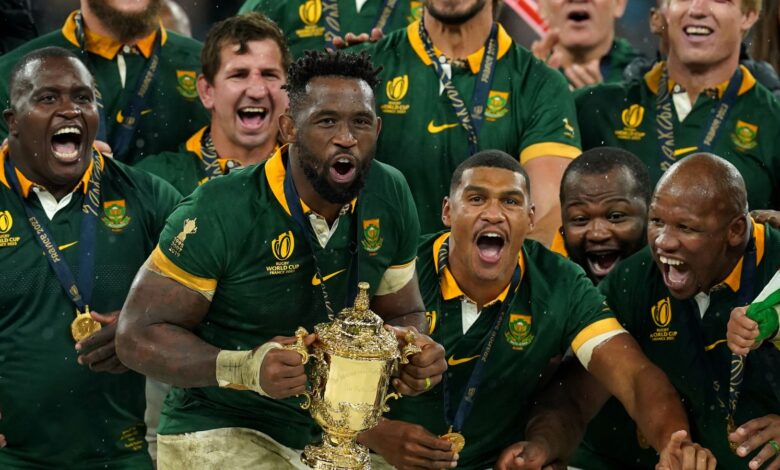
In 2023, South Africa made history once more by winning their fourth Rugby World Cup title, defeating New Zealand in a dramatic final. This achievement made them the most successful nation in Rugby World Cup history.
New Zealand’s Continued Dominance (2011 and 2015)
New Zealand added to their 1987 triumph by winning the Rugby World Cup in 2011, which they hosted. The final against France was tense and low-scoring, but the All Blacks held on to secure victory. This win ended a long drought and relieved decades of pressure on the team.
The All Blacks then achieved something truly remarkable by winning back-to-back titles in 2015. Hosted by England, the 2015 Rugby World Cup final saw New Zealand defeat Australia with an outstanding all-round performance. Players like Richie McCaw, Dan Carter, and Beauden Barrett played pivotal roles. This victory confirmed New Zealand as one of the greatest teams in rugby history.
England’s Sole Title (2003)
England remains the only Northern Hemisphere nation to win the Rugby World Cup. Their victory came in 2003 when the tournament was hosted by Australia. England defeated the host nation in the final thanks to Jonny Wilkinson’s iconic drop goal in extra time. This moment is still regarded as one of the greatest in rugby history. England’s success was built on discipline, strong forward play, and world-class kicking.
France’s Near Misses
Although France has never won the Rugby World Cup, they have reached the final three times (1987, 1999, and 2011). Each time, they were narrowly defeated, often after dramatic and controversial matches. Despite not being among the Rugby World Cup winners, France remains one of the most influential and unpredictable teams in the tournament’s history.
Complete List of Rugby World Cup Winners
As of the most recent tournament, the Rugby World Cup winners are:
- New Zealand: 1987, 2011, 2015
- Australia: 1991, 1999
- South Africa: 1995, 2007, 2019, 2023
- England: 2003
These four nations have dominated the tournament, highlighting the competitive gap between the traditional rugby powers and emerging nations.
Why Southern Hemisphere Teams Dominate
A key trend among Rugby World Cup winners is the dominance of Southern Hemisphere teams. New Zealand, South Africa, and Australia have collectively won the majority of titles. This success is often attributed to their rugby culture, strong domestic competitions, emphasis on physicality, and early adoption of professional structures.
However, Northern Hemisphere teams such as England, France, Ireland, and Wales continue to improve, making future tournaments increasingly competitive.
The Legacy of Rugby World Cup Winners
Winning the Rugby World Cup transforms nations and players alike. Champions gain global recognition, inspire future generations, and influence how the game is played worldwide. Many tactical innovations, training methods, and playing styles can be traced back to successful Rugby World Cup winners.
The tournament itself has grown massively since 1987, expanding to include more teams and reaching millions of fans globally. Each new edition adds another chapter to rugby’s rich history.
Conclusion
The history of Rugby World Cup winners tells a story of dominance, rivalry, and unforgettable moments. From New Zealand’s early supremacy to South Africa’s record-breaking success, each champion has shaped the evolution of the sport. As rugby continues to grow worldwide, future tournaments promise new contenders, fresh narratives, and the possibility of new names joining the elite list of Rugby World Cup winners.
3 Comments